

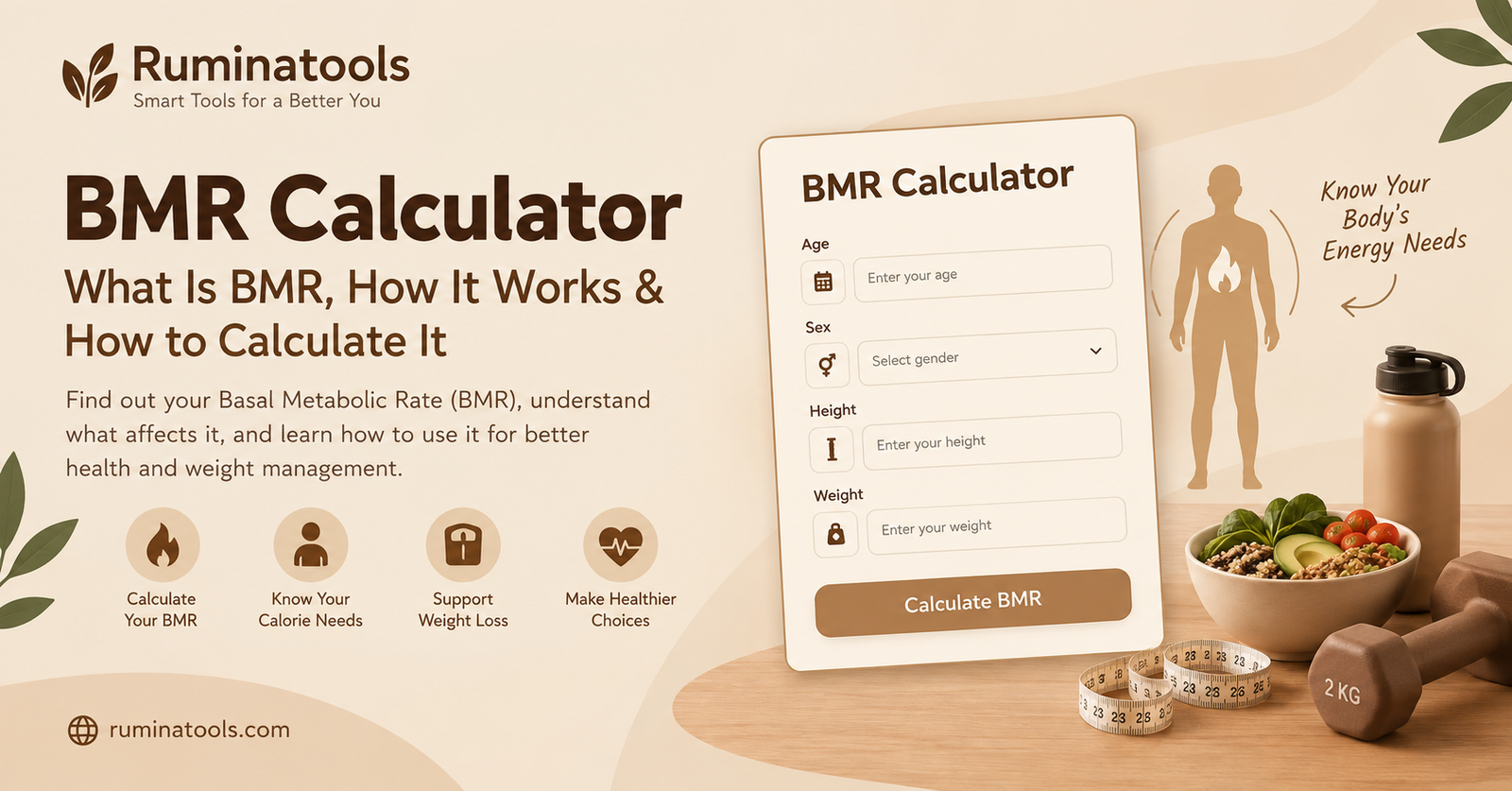
If you have ever wondered how many calories your body needs even when you are doing nothing, your BMR calculator can give you a useful estimate. Basal Metabolic Rate, or BMR, represents the energy your body needs to maintain essential functions while at rest. Your heart keeps beating, your lungs keep working, your body maintains its temperature, and your cells continue performing necessary processes even when you are sleeping or resting. Understanding BMR can help you make sense of your daily calorie needs, weight management goals, and overall energy expenditure. However, BMR is only one part of your total calorie needs. Your activity level, food intake, and other factors also affect how much energy you use throughout the day.
What Is BMR and What Does a BMR Calculator Tell You?
BMR stands for Basal Metabolic Rate. It is an estimate of the minimum amount of energy your body requires to support essential physiological functions while at rest. These functions include breathing, blood circulation, maintaining body temperature, and supporting normal cellular activity.
A BMR calculator uses information such as your age, body weight, height, and sex to estimate your resting energy requirement. Cleveland Clinic explains that BMR varies from person to person and that equations can estimate metabolic rate using these characteristics.
Your BMR is expressed in calories per day. For example, if a calculator estimates your BMR at 1,600 calories per day, that does not automatically mean you should eat exactly 1,600 calories every day. It means your estimated baseline energy requirement at rest is around that amount.
What Does BMR Mean?
BMR describes the energy your body needs for basic survival functions. Think of it as the energy cost of keeping your body operating before considering exercise, walking, household activities, or other movement.
This is why BMR should not be confused with your total daily calorie requirement. Your actual energy expenditure throughout the day is usually higher because you move, exercise, digest food, and perform normal daily activities.
BMR vs RMR: What Is the Difference?
BMR and resting metabolic rate (RMR) are closely related terms, but they are not technically identical. Both describe energy expenditure while the body is resting, but BMR is associated with stricter physiological conditions.
Online calculators often provide an estimate of resting energy expenditure rather than directly measuring metabolism in a laboratory. For everyday calorie planning, the distinction may not substantially change how people use the number, but it is useful to understand that the terms are not perfectly interchangeable.
How Is BMR Calculated?
A BMR estimate can be produced using different predictive equations. One commonly used approach is the Mifflin-St Jeor equation, which was developed from measurements of resting energy expenditure in healthy adults.
The equation uses four major pieces of information:
- Body weight
- Height
- Age
- Sex
For the Mifflin-St Jeor equation, weight is entered in kilograms and height in centimeters.
BMR Formula for Men
For men, the commonly used Mifflin-St Jeor equation is:
BMR = (10 × weight in kg) + (6.25 × height in cm) − (5 × age) + 5
For example, consider a 30-year-old man weighing 80 kg with a height of 180 cm:
BMR = (10 × 80) + (6.25 × 180) − (5 × 30) + 5
BMR = 800 + 1,125 − 150 + 5
BMR = 1,780 calories/day
This is an estimate of his resting energy expenditure, not his total daily calorie requirement.
BMR Formula for Women
For women, the Mifflin-St Jeor equation is:
BMR = (10 × weight in kg) + (6.25 × height in cm) − (5 × age) − 161
For example, consider a 30-year-old woman weighing 65 kg and measuring 165 cm:
BMR = (10 × 65) + (6.25 × 165) − (5 × 30) − 161
BMR = 650 + 1,031.25 − 150 − 161
BMR = 1,370.25 calories/day
The result is an estimate and should not be interpreted as an exact measurement of the person’s metabolism.
The Mifflin-St Jeor equation was published after research involving 498 healthy adults and remains a commonly referenced predictive equation for resting energy expenditure.
How to Use a BMR Calculator
Using a BMR calculator is generally straightforward. You enter your personal information, and the calculator applies a metabolic equation to estimate your daily resting calorie requirement.
Most calculators ask for:
- Age
- Sex
- Height
- Weight
- Measurement units
After entering the information, the calculator provides an estimated BMR in calories per day.
For example, someone might receive a result of 1,500 calories per day. This does not mean that person burns only 1,500 calories during an entire day. It represents an estimated resting requirement. Walking, working, exercising, digesting food, and other activities require additional energy.
BMR Calculation Example
Suppose a 35-year-old woman weighs 70 kg and is 170 cm tall.
Using the Mifflin-St Jeor equation:
BMR = (10 × 70) + (6.25 × 170) − (5 × 35) − 161
BMR = 700 + 1,062.5 − 175 − 161
BMR = 1,426.5 calories/day
Her estimated BMR would therefore be approximately 1,427 calories per day.
The important point is that this number is an estimate. Research comparing predictive equations with measured resting metabolic rate shows that equations can have individual errors, so a calculator should be treated as a practical starting point rather than a laboratory measurement.
What Is a Healthy BMR?
There is no single BMR number that can be considered healthy or ideal for everyone. Your estimated metabolic rate depends on several personal characteristics, including your body size, age, height, sex, and body composition.
For this reason, comparing your BMR with another person’s BMR does not necessarily tell you who has a healthier metabolism. A larger person may naturally require more energy at rest than a smaller person.
Instead of focusing on whether your BMR is “high” or “low,” it is more useful to understand how your estimated BMR fits into your overall energy needs.
A calculator result also should not be used by itself to diagnose a medical condition or determine whether your metabolism is healthy. If you have concerns about unexplained weight changes or metabolic health, a healthcare professional can provide a more appropriate evaluation.
What Factors Affect Your Basal Metabolic Rate?
Your basal metabolic rate is influenced by multiple characteristics. This is one reason two people with the same age or weight can still have different estimated energy requirements.
Age
Age is included in many BMR prediction equations. As people get older, changes in body composition and other physiological factors can influence resting energy expenditure.
Height and Weight
Body size affects energy requirements. In general, a larger body requires more energy to maintain its tissues and basic functions.
Sex
Common BMR equations use sex-specific calculations because average body composition and resting energy expenditure differ between men and women.
Lean Body Mass
Lean body mass, including muscle and other fat-free tissues, is an important contributor to resting energy expenditure. This is why body composition can provide useful context when interpreting a BMR estimate.
Genetics and Other Factors
Metabolism is influenced by more than the information entered into an online calculator. Genetics, hormones, health conditions, body composition, environmental conditions, and other physiological factors can affect energy expenditure.
Mayo Clinic notes that metabolism involves converting food and drinks into energy and that the body continues using energy even while resting. It also emphasizes that body weight is influenced by both energy intake and physical activity rather than metabolism alone.
BMR Calculator for Weight Loss: How Many Calories Do You Need?
A BMR calculator can be useful when starting to understand your calorie requirements for weight management, but BMR should not automatically become your daily calorie target.
Your body uses energy for much more than basic resting functions. You also burn calories through physical activity, everyday movement, digestion, and other processes.
For weight loss, the broader concept is energy balance. When average energy intake is lower than average energy expenditure over time, body weight can decrease. However, individual results vary, and weight changes are affected by many factors.
A practical approach is to use your estimated BMR as a starting point and then account for your activity level to estimate your total daily energy expenditure (TDEE).
BMR and Calorie Deficit
A calorie deficit occurs when you consume fewer calories than your body uses over time.
For example, if your estimated total daily energy expenditure is 2,300 calories, eating fewer calories than that may create an energy deficit. The appropriate calorie target depends on the individual and should be realistic and nutritionally adequate.
Simply eating below your BMR is not the correct definition of a calorie deficit. BMR describes resting energy requirements, while your daily energy expenditure includes additional calorie use.
For sustainable weight management, it is better to consider your complete daily energy needs rather than focusing on BMR alone.
BMR vs TDEE: How to Calculate Your Daily Calorie Needs
TDEE stands for Total Daily Energy Expenditure. While BMR estimates the energy needed for basic resting functions, TDEE attempts to account for the calories you use throughout a normal day.
A simplified approach is:
TDEE ≈ BMR × Activity Factor
The activity factor represents your typical level of physical activity.
For example:
| Activity Level | General Description |
|---|---|
| Sedentary | Little structured exercise and mostly low daily movement |
| Lightly Active | Some exercise or regular light movement |
| Moderately Active | Regular exercise and moderate daily movement |
| Very Active | Frequent exercise and high levels of daily activity |
These categories are estimates rather than exact measurements. Your actual energy expenditure can vary from day to day.
Why TDEE Matters
Suppose your BMR is 1,600 calories per day. You still walk around, work, exercise, prepare meals, digest food, and perform other activities.
Your total daily calorie expenditure could therefore be considerably higher than your BMR.
This is why someone trying to estimate daily calorie needs should generally consider TDEE rather than treating BMR as the amount of food they should consume.
BMR Calculator for Women vs Men
BMR calculations for women and men commonly use the same basic inputs but different constants in equations such as Mifflin-St Jeor.
For men:
BMR = (10 × weight) + (6.25 × height) − (5 × age) + 5
For women:
BMR = (10 × weight) + (6.25 × height) − (5 × age) − 161
These equations use weight in kilograms, height in centimeters, and age in years.
BMR Calculator for Women
Women can use their age, weight, height, and sex-specific equation to estimate resting energy expenditure.
The resulting number should be viewed as an estimate of energy use at rest. It should then be considered alongside physical activity and other factors when estimating total daily calorie needs.
BMR Calculator for Men
Men can use the corresponding Mifflin-St Jeor equation to estimate resting energy expenditure.
The difference between male and female formulas does not mean every individual follows the same metabolic pattern. Individual body composition and other factors still influence actual energy expenditure.
The Mifflin-St Jeor equations are documented in the original research and in clinical references such as NCBI’s Endotext.
Why Knowing Your BMR Matters
Knowing your estimated BMR gives you a useful starting point for understanding how your body uses energy.
It can help you:
- Understand your estimated resting calorie requirement
- Estimate your total daily calorie needs
- Better understand TDEE
- Plan a calorie deficit for weight management
- Compare changes in estimated energy needs over time
- Understand why calorie requirements differ between people
However, BMR is only one part of the bigger picture.
Your daily calorie needs are affected by physical activity, body composition, food intake, and other factors. Mayo Clinic explains that the body continues using energy at rest and that physical activity also plays an important role in overall energy balance.
For this reason, the most useful way to interpret your BMR is as a baseline estimate, not as a complete description of your metabolism.
BMR Calculator FAQs
What is a BMR calculator?
A BMR calculator estimates the number of calories your body may need each day to support basic functions while at rest.
What is a normal BMR?
There is no single normal BMR for everyone. BMR varies according to factors such as age, height, weight, sex, and body composition.
Is a higher BMR better?
Not necessarily. A higher BMR generally means greater estimated energy use at rest, but BMR alone does not determine overall health.
How accurate is a BMR calculator?
A BMR calculator provides an estimate rather than a direct measurement. Individual accuracy can vary because prediction equations cannot account for every physiological factor.
Should I eat below my BMR to lose weight?
BMR should not automatically be used as your calorie intake target. Weight-loss planning should consider your total daily energy expenditure and individual circumstances.
Does muscle increase BMR?
Muscle and other lean tissues contribute to resting energy expenditure. However, changes in BMR depend on overall body composition and other factors.
Does BMR decrease with age?
Age is associated with changes in resting energy expenditure, although the effect varies between individuals and is influenced by changes in body composition and other factors.
What is the difference between BMR and TDEE?
BMR estimates energy required for basic resting functions, while TDEE estimates total energy expenditure across a normal day.
Can BMR change over time?
Yes. Changes in body weight, body composition, age, and other physiological factors can change estimated or measured resting energy expenditure.
Is BMR the same as resting metabolic rate?
They are closely related but technically different concepts. BMR is measured under more restrictive conditions, while RMR is generally measured under less strict resting conditions.
Conclusion
A BMR calculator is a practical way to estimate how many calories your body needs to support essential functions while at rest. Your age, height, weight, sex, and body composition all play a role in determining your estimated basal metabolic rate.
The most important thing to remember is that BMR is not your total daily calorie requirement. To understand how many calories you may need throughout the day, you also need to consider physical activity and other components of energy expenditure.
For weight management, use your BMR as a starting point, estimate your TDEE, and interpret the result as an estimate rather than an exact measurement. This gives you a more complete picture of your daily energy needs and helps you make more informed decisions about calorie intake and activity.